The Research Is Clear
The Education Endowment Foundation (EEF) has studied what really impacts children's learning. Their findings might surprise you:
What works:
- Parents reading to and with their children from an early age
- Having conversations about learning
- High expectations coupled with warmth and encouragement
- Providing a calm, organised environment for homework
- Engaging with the school and showing that education matters
What doesn't work:
- Excessive tutoring or drilling
- Doing homework for your child
- Creating a pressured, anxious atmosphere around achievement
- Comparing your child to siblings or peers
- Ignoring your child's emotional wellbeing in pursuit of academic results
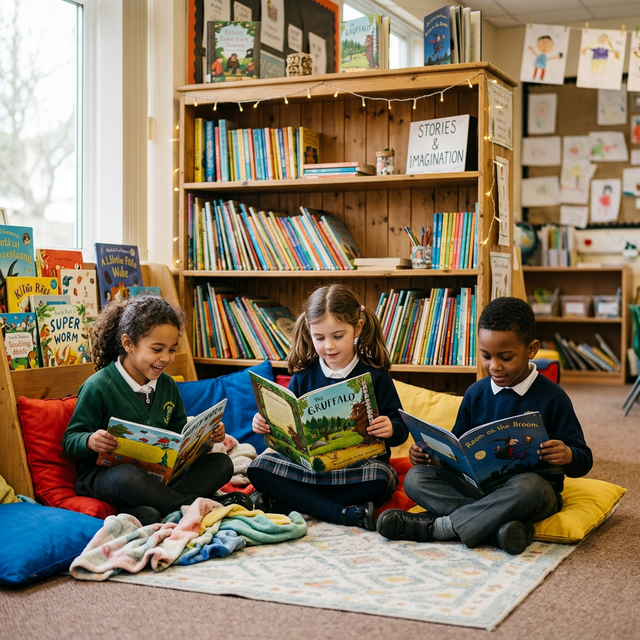
The single most powerful thing you can do is read with and to your child: from birth right through to secondary school.
Reading: The Foundation of Everything
For younger children (3-7):
- Read aloud every day: 15 minutes at bedtime is enough
- Talk about the pictures: "What do you think is happening here?"
- Play with sounds: rhyming games, I-spy, silly songs
- Let them see you read: children model the behaviour they see
- Visit the library regularly: it's free and wonderful
For older children (7-11):
- Keep reading aloud: even confident readers enjoy being read to
- Discuss books: "What was the most interesting thing you read today?"
- Audiobooks count: they build vocabulary and comprehension
- Let them choose: graphic novels, non-fiction, joke books, it all counts
- Recommend, don't impose: "I think you'd love this" works better than "You need to read this"
For secondary school:
- Talk about current affairs: this builds critical thinking and vocabulary
- Keep books visible at home: on shelves, on coffee tables, in bedrooms
- Share what you're reading: model lifelong reading
- Don't police their reading choices: any reading is better than no reading
Maths in Daily Life
You don't need workbooks. The best maths learning happens naturally:
- Cooking: "The recipe says 200g, we need to make half that. How much is half?"
- Shopping: "These are 3 for £2. How much would 6 cost?"
- Travelling: "We need to arrive at 3pm and the journey takes 45 minutes. When should we leave?"
- Pocket money: budgeting, saving for something, counting change
- Board games: Monopoly (money), chess (strategy), Uno (number patterns)
- Sport: scores, statistics, measurements, timing
Homework: Making It Work
Create the right environment
- A consistent time and place (not in front of the TV)
- Good lighting and minimal distractions
- All materials to hand (pencils, ruler, paper)
- A drink and a snack beforehand
The right level of help
- Ask "What do you need to do?" rather than telling them
- Guide, don't do it for them, "What's the first step?"
- Praise effort more than results, "I can see you worked really hard on that"
- Let them struggle a bit: productive struggle builds resilience
- If they genuinely can't do it, tell the teacher: homework should reinforce learning, not cause distress
If homework is causing tears
- Stop. Step away. Come back to it later or the next day
- Write a note to the teacher explaining the difficulty
- Ask the teacher for guidance on how long homework should take
- Remember: your relationship with your child matters more than any piece of homework
Building a Love of Learning
This is the ultimate goal, not grades, not scores, but genuine curiosity and enjoyment.
- Follow their interests: if they're fascinated by dinosaurs, lean into it (books, museums, documentaries)
- Ask questions together: "I wonder why..." and then look it up together
- Visit museums, galleries, and places of interest: many are free
- Try new things: cooking, gardening, building, coding, art
- Celebrate curiosity: "What a great question!" is one of the most powerful things you can say
Useful Resources
- BBC Bitesize, curriculum-aligned support
- Khan Academy, free maths and science
- Oak National Academy, free video lessons
- Education Endowment Foundation parent resources
- Library card, free access to thousands of books
The most important thing you can offer your child isn't academic knowledge, it's the belief that learning is interesting, enjoyable, and worth pursuing. That attitude will carry them further than any test score.