Beyond the Countryside Myth
When most people picture forest school, they imagine a rural idyll - children deep in ancient woodland, miles from the nearest road. And while plenty of village schools do have that kind of access, the fastest growth in forest school provision is happening somewhere altogether different: in England's cities.
According to our data, over 900 schools in metropolitan areas now offer some form of forest school or structured outdoor learning. That includes schools in inner London, central Birmingham, urban Manchester, and the heart of Leeds. These aren't schools with rolling grounds and private woodlands. Many of them have concrete playgrounds, limited green space, and children who rarely experience the natural world outside of school.
So how are they making it work? And why are so many urban schools deciding it's worth the effort?
The Park Down the Road
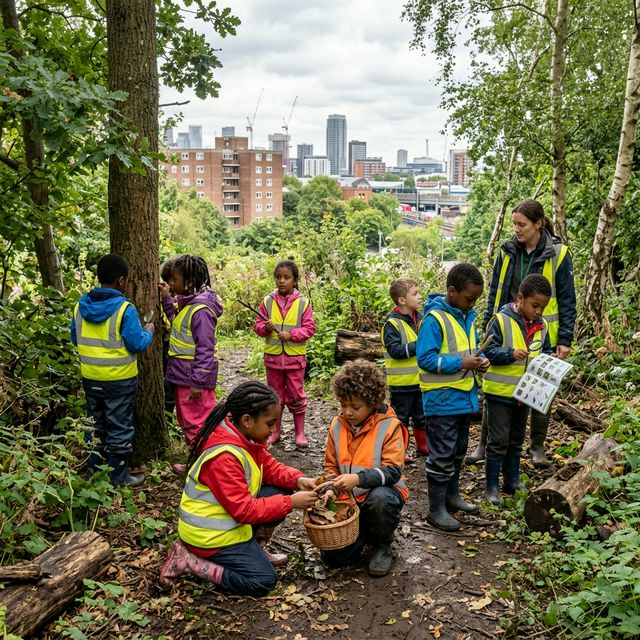
The most common approach is disarmingly simple: walk to the nearest green space. For many urban schools, a public park, a canal towpath, a churchyard, or a patch of urban woodland is within a ten-minute walk. With the right risk assessment, a qualified forest school leader, and enough adult volunteers, that's all it takes.
St Matthew's Primary in Tower Hamlets takes its Reception class to Victoria Park every Wednesday morning. The school sits on a busy road in one of London's most densely populated boroughs. But the park is a seven-minute walk away, and once the children pass through the gates and into the copse of mature trees near the lake, the noise and pace of the city simply fall away.
"You can see them physically change," says the school's forest school leader. "Their shoulders drop. Their voices get quieter. Some of our children have never walked on grass before starting school. For them, this is genuinely new territory."
Transforming What You've Got
Other schools are taking a different approach - transforming the spaces they already have. A growing number of urban primaries are converting sections of their grounds into woodland-style environments, planting trees, creating wild areas, building mud kitchens, and installing log circles.
This doesn't happen overnight, and it doesn't require a fortune. The Woodland Trust's free tree packs provide hundreds of native saplings to schools each year. Community volunteers can build a mud kitchen from reclaimed pallets in a weekend. The investment is more about mindset than money.
A primary school in Salford turned an unused strip of land between two buildings into what they call "the wild corridor" - a narrow but densely planted space with birch trees, willow arches, a bug hotel, and a fire circle made from reclaimed bricks. It's not exactly Epping Forest. But for the children who use it every week, it's their woods.
Why Urban Children Need This Most
There's an uncomfortable irony at the heart of forest school provision in England. The children who most need access to nature - those in crowded urban areas with small or no gardens, high levels of air pollution, and limited safe outdoor play space - are often the least likely to get it.
Research from Natural England consistently shows that children from disadvantaged urban backgrounds spend significantly less time in natural environments than their suburban or rural peers. They are also more likely to experience the health consequences of that disconnect: higher rates of childhood obesity, poorer mental health, and lower levels of physical fitness.
Forest school in urban settings directly addresses this inequality. It doesn't just give children access to nature - it gives them regular, structured, educationally valuable time in natural environments that they might otherwise never visit.
The Logistics Aren't as Hard as You'd Think
Schools considering forest school in urban areas often worry about the practicalities. How do you get thirty children safely to a park? What about safeguarding? What about the weather? What about the cost?
The answers, from schools already doing it, are reassuringly practical.
Getting there is usually manageable. Most urban schools have a green space within walking distance. The Forest School Association recommends that the site should be within a fifteen-minute walk, and for most urban schools, this is achievable. Parent volunteers often help with walking buses on forest school days.
Safeguarding follows the same principles as any school trip. A risk assessment covers the route and the site. Staff ratios are maintained. The site is checked before each session. In practice, the consistent use of the same site week after week actually makes safeguarding easier, because staff and children become familiar with it.
Weather is embraced rather than avoided. The forest school mantra - "there's no such thing as bad weather, only bad clothing" - applies in cities just as much as the countryside. Many schools build up a stock of waterproofs and wellies in various sizes, sometimes funded by PTA fundraising or community donations.
Cost is often lower than people expect. A qualified Level 3 Forest School Leader costs around £1,500 to train, and many schools fund this through their professional development budget or pupil premium. Some multi-academy trusts now train a forest school leader for each school in the group, creating a network of expertise.
What the Children Say
The most persuasive argument for urban forest school doesn't come from policy documents or research papers. It comes from the children.
A Year 4 child at a school in Hackney, asked to describe her favourite thing about forest school: "It's the only place where no one tells me to sit still."
A Year 1 boy in Wolverhampton: "I found a worm and it was alive and I held it and it tickled."
A Year 6 child in central Manchester, writing in her forest school journal: "In the woods I don't worry about things. My brain goes quiet."
These aren't exceptional responses. Talk to any urban school running forest school and you'll hear the same themes repeated: calm, freedom, discovery, joy. For children whose daily experience is dominated by concrete, traffic, and screens, an hour or two in nature each week can feel like stepping into another world.
A Growing Movement
The numbers tell the story. Five years ago, forest school in urban areas was unusual enough to make the local news. Today, it's becoming routine. Education networks like the Forest School Association, the Outdoor Classroom Day campaign, and Learning Through Landscapes are all reporting sharp increases in urban membership.
Local authorities are taking notice too. Several metropolitan councils, including Tower Hamlets, Salford, and Bristol, have established outdoor learning coordinators whose job is to help schools access green spaces and develop nature-based programmes.
The message is clear: forest school doesn't require a forest. It requires commitment, creativity, and a willingness to let children get muddy. For urban schools, those qualities are already in abundant supply.
Further Reading
- Explore our interactive forest schools map to see which schools near you offer forest school or outdoor learning
- Breakfast clubs and wraparound care covers another form of extended school provision
- How to choose the right primary school is our complete guide to school selection