Regional Guidance: This article discusses Ofsted, the inspectorate for England. If your school is in Scotland, Wales, or Northern Ireland, it is inspected under different frameworks by Education Scotland (HMIe), Estyn, or the Education and Training Inspectorate (ETI) respectively.
The Four Grades
Ofsted rates schools on a four-point scale. While the format is changing (more on that below), understanding what each grade means remains essential for any parent trying to assess a school.
The school is exceptionally good in all areas. The quality of education is consistently excellent, behaviour is exemplary, and the school's leadership is driving continuous improvement. About 16% of schools hold this grade.
The school consistently does a good job for its pupils. Teaching is effective, children are well-supported, and leadership is strong. This is a genuinely positive outcome - about 65% of schools are rated Good, and it represents a high standard.
The school is not yet Good but isn't failing. Specific areas need work - perhaps the quality of teaching in some subjects, the curriculum, or leadership capacity. The school typically has a plan to address these issues and will be re-inspected sooner than usual.
The school has serious weaknesses. This may trigger special measures - intensive support and monitoring - or a notice to improve. Leadership may be replaced, and the school could be converted to an academy. About 2% of schools are rated Inadequate.
How to Read Beyond the Headline
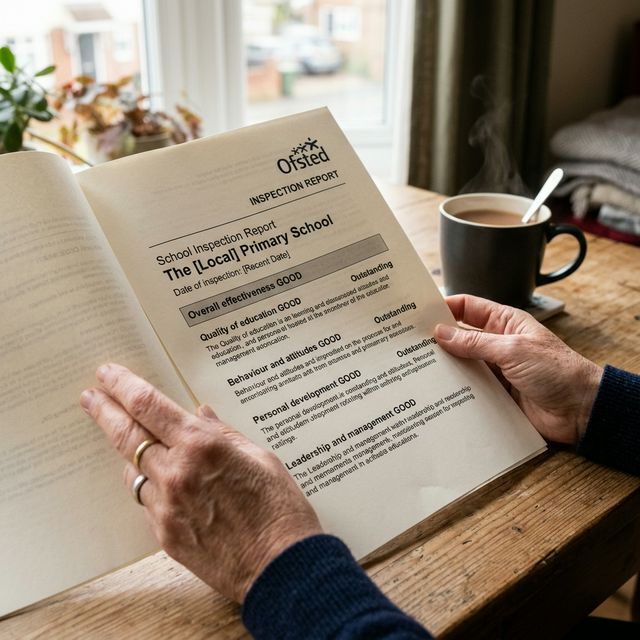
The headline grade gets the attention, but the full report tells you much more. Every Ofsted report includes sub-judgements in key areas: Quality of Education (covering curriculum, teaching, and outcomes), Behaviour and Attitudes, Personal Development, and Leadership and Management. For early years and sixth form, there are additional separate judgements.
Pay particular attention to the Quality of Education judgement - this is where Ofsted assesses the school's curriculum (is it ambitious and well-sequenced?), how effectively teachers deliver it, and whether children are actually learning and remembering what they're taught. A school might be "Good" overall but have a Quality of Education judgement of Requires Improvement, which should prompt questions.
Read the narrative text carefully. Ofsted inspectors are trained to write precisely. Phrases like "leaders have identified this as a priority" usually means the school knows it has a problem but hasn't fixed it yet. "Some inconsistency" means there's a real issue in certain areas. "The school should take further action to…" at the end of the report tells you exactly what Ofsted thinks needs improving.
You can read any school's Ofsted report on the Ofsted reports website, or check a school's rating directly on What School, where we display grades alongside other performance data.
How Ofsted Is Changing
Ofsted is undergoing the most significant change to its inspection framework in years. From September 2024, the traditional single-word headline judgement (Outstanding, Good, etc.) is being phased out and replaced with "report cards" - a more detailed format that gives separate grades across multiple areas without collapsing everything into one overall word.
This change was prompted partly by the tragic death of headteacher Ruth Perry in 2023, which raised serious questions about the impact of single-word judgements on school leaders' mental health and the fairness of reducing a complex institution to a single label. The new report cards are designed to give parents more nuanced information while reducing the "cliff edge" pressure of a headline grade change.
The transition is happening gradually. Schools inspected before September 2024 retain their existing grades. Schools inspected from September 2024 onwards receive the new-format report cards. During the transition period, parents will encounter both formats, which can be confusing. The underlying quality areas being assessed remain largely the same - it's the presentation and the absence of a single summarising word that's different.
Beyond Ofsted - What Else to Consider
Ofsted is important, but it's a snapshot. An inspection typically lasts one or two days, and the report reflects what inspectors observed during that visit. A school might have improved significantly since its last inspection, or it might have declined. The date of the report matters - a "Good" rating from 2019 tells you less than one from last year.
Complement the Ofsted report with other sources of information. Published performance data (SATs results, GCSE results, Progress 8 scores) gives you objective measures of how children perform academically. Parent View - the Ofsted parent survey - shows what parents at the school think about behaviour, teaching, leadership, and communication. A school visit gives you an atmosphere that no report can capture.
A Requires Improvement school with passionate new leadership and a clear plan may be a better choice for your child than a coasting Outstanding school that hasn't been inspected in five years. An Inadequate school in special measures may have transformed since the rating was issued. Context matters. Use Ofsted as one input among many, not as the sole basis for your decision.
Note: Ofsted's inspection framework is evolving. For the latest information on how schools are inspected and rated, visit GOV.UK Ofsted.