The Research Is Clear
The Education Endowment Foundation (EEF) has studied what really impacts children's learning. Their findings might surprise you:
What works:
- Parents reading to and with their children from an early age
- Having conversations about learning
- High expectations coupled with warmth and encouragement
- Providing a calm, organised environment for homework
- Engaging with the school and showing that education matters
What doesn't work:
- Excessive tutoring or drilling
- Doing homework for your child
- Creating a pressured, anxious atmosphere around achievement
- Comparing your child to siblings or peers
- Ignoring your child's emotional wellbeing in pursuit of academic results
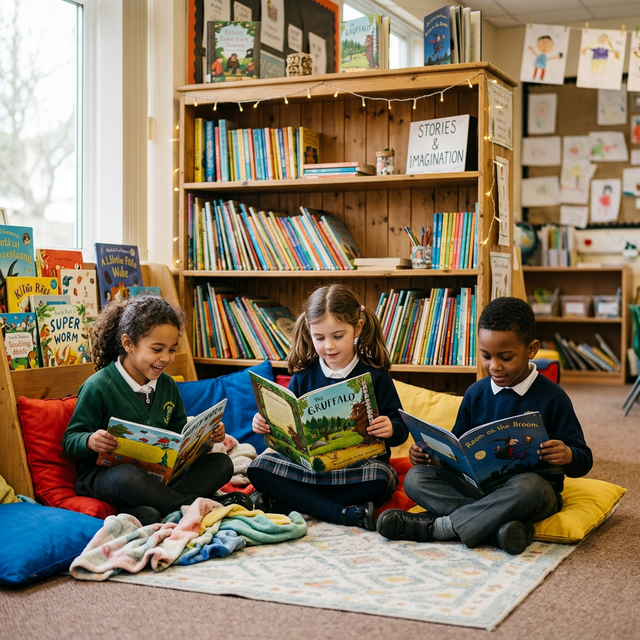
The single most powerful thing you can do is read with and to your child — from birth right through to secondary school.
Reading: The Foundation of Everything
For younger children (3-7):
- Read aloud every day — 15 minutes at bedtime is enough
- Talk about the pictures — "What do you think is happening here?"
- Play with sounds — rhyming games, I-spy, silly songs
- Let them see you read — children model the behaviour they see
- Visit the library regularly — it's free and wonderful
For older children (7-11):
- Keep reading aloud — even confident readers enjoy being read to
- Discuss books — "What was the most interesting thing you read today?"
- Audiobooks count — they build vocabulary and comprehension
- Let them choose — graphic novels, non-fiction, joke books — it all counts
- Recommend, don't impose — "I think you'd love this" works better than "You need to read this"
For secondary school:
- Talk about current affairs — this builds critical thinking and vocabulary
- Keep books visible at home — on shelves, on coffee tables, in bedrooms
- Share what you're reading — model lifelong reading
- Don't police their reading choices — any reading is better than no reading
Maths in Daily Life
You don't need workbooks. The best maths learning happens naturally:
- Cooking: "The recipe says 200g — we need to make half that. How much is half?"
- Shopping: "These are 3 for £2. How much would 6 cost?"
- Travelling: "We need to arrive at 3pm and the journey takes 45 minutes. When should we leave?"
- Pocket money: budgeting, saving for something, counting change
- Board games: Monopoly (money), chess (strategy), Uno (number patterns)
- Sport: scores, statistics, measurements, timing
Homework: Making It Work
Create the right environment
- A consistent time and place (not in front of the TV)
- Good lighting and minimal distractions
- All materials to hand (pencils, ruler, paper)
- A drink and a snack beforehand
The right level of help
- Ask "What do you need to do?" rather than telling them
- Guide, don't do it for them — "What's the first step?"
- Praise effort more than results — "I can see you worked really hard on that"
- Let them struggle a bit — productive struggle builds resilience
- If they genuinely can't do it, tell the teacher — homework should reinforce learning, not cause distress
If homework is causing tears
- Stop. Step away. Come back to it later or the next day
- Write a note to the teacher explaining the difficulty
- Ask the teacher for guidance on how long homework should take
- Remember: your relationship with your child matters more than any piece of homework
Building a Love of Learning
This is the ultimate goal — not grades, not scores, but genuine curiosity and enjoyment.
- Follow their interests — if they're fascinated by dinosaurs, lean into it (books, museums, documentaries)
- Ask questions together — "I wonder why..." and then look it up together
- Visit museums, galleries, and places of interest — many are free
- Try new things — cooking, gardening, building, coding, art
- Celebrate curiosity — "What a great question!" is one of the most powerful things you can say
Useful Resources
- BBC Bitesize — curriculum-aligned support
- Khan Academy — free maths and science
- Oak National Academy — free video lessons
- Education Endowment Foundation parent resources
- Library card — free access to thousands of books
The most important thing you can offer your child isn't academic knowledge — it's the belief that learning is interesting, enjoyable, and worth pursuing. That attitude will carry them further than any test score.