Arriving at the Woods
It's a Tuesday morning in late October, and twenty Year 2 children are walking single file along a muddy track into a patch of woodland on the edge of their school grounds. They're wearing waterproof dungarees over their uniforms, wellies that have seen better days, and expressions that range from barely-contained excitement to quiet contemplation.
Their forest school leader, Mrs Davies - or "Mrs D in the woods," as the children call her - holds up a hand at the entrance to their base camp. This is the threshold. Beyond it, everything changes.
"What's our first rule?" she asks.
"Respect the woods!" comes the chorus.
It's a small thing, this ritual. But rituals matter in forest school. They mark the shift from classroom to woodland, from desks to earth, from indoor voices to the kind of voices that belong among trees.
The Opening Circle
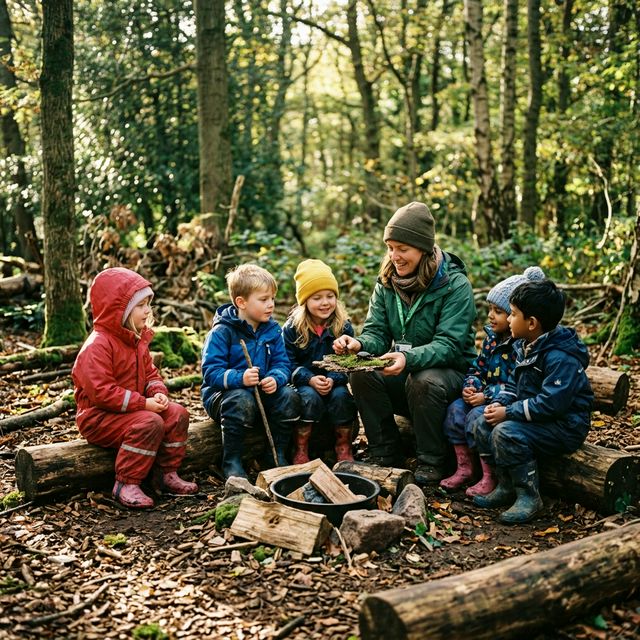
The session begins, as it always does, on the log circle. Twelve stumps arranged around a fire pit that won't be lit today (fire sessions happen fortnightly, and today isn't one of those days). The children sit, and Mrs D asks them to close their eyes and listen.
"What can you hear?"
Silence. Then, gradually, hands shoot up.
"A woodpecker!"
"The wind in the leaves."
"My tummy rumbling."
This isn't just a cute warm-up. It's a deliberate pedagogical choice. Forest school practitioners call it "tuning in" - shifting children's attention from the busy, screen-filled world they normally inhabit to the slower, more textured environment around them. Research from the University of Edinburgh found that this simple practice of attentive listening in nature reduces cortisol levels in children within minutes.
Mrs D then introduces the morning's invitation. In forest school, activities are framed as invitations rather than instructions. Today's invitation is to build shelters that could protect a small woodland creature from the rain.
Free Exploration
What happens next would make some adults nervous. The children scatter. Some head straight for the stick pile. Others wander. A pair of girls crouch by a puddle, poking at something with intense fascination. A boy called Ravi stands perfectly still next to an oak tree, his palm pressed against the bark.
None of this is wasted time. Forest school's founding philosophy, drawn from Scandinavian friluftsliv (open-air living), holds that children learn most effectively when they have the freedom to direct their own play. The practitioner's role isn't to teach in the traditional sense. It's to create a rich environment and then step back, observing carefully and intervening only when needed.
Mrs D is watching Ravi. She doesn't interrupt him. Later, she'll note in her observation journal that he spent four minutes in quiet contact with the tree - the longest period of calm focus she's recorded for him this term. Ravi is on the autism spectrum, and the woodland seems to give him something the classroom can't.
Building and Making
By half past ten, the woodland is humming with activity. Three groups have formed organically around different projects.
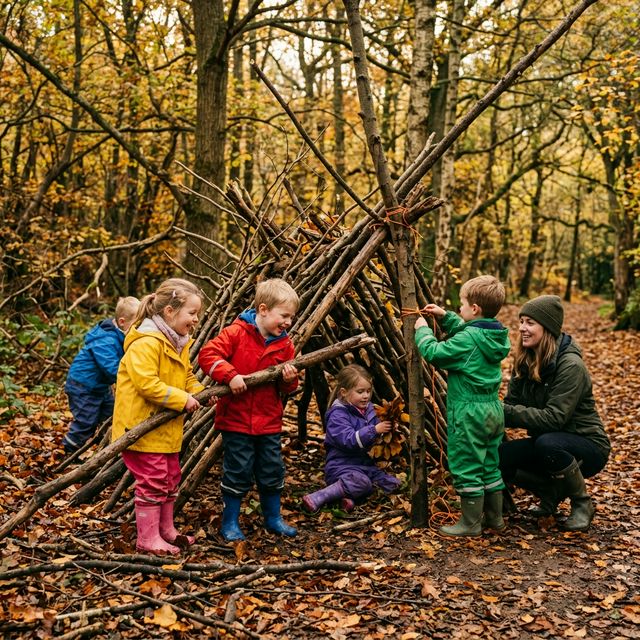
Near the boundary fence, a team of six has committed to an ambitious shelter. They're dragging branches twice their height, negotiating who holds what, disagreeing about the angle of the roof. One child suggests weaving smaller sticks through the frame to fill the gaps. Another fetches handfuls of leaves to pile on top. The engineering is surprisingly sound.
By the mud kitchen - a sturdy wooden workbench furnished with old pots, spoons, and sieves - another group is deep in imaginative play. They're running a restaurant. The menu includes mud soup, acorn crumble, and leaf salad. A girl called Anya is the head chef, issuing instructions with the authority of someone who has watched a lot of MasterChef.
The third group has found a beetle under a rotten log and has gone entirely off-script. Mrs D joins them with a magnifying glass and an insect identification card. What follows is a fifteen-minute conversation about decomposition that covers more science than the textbook would manage in an hour.
The Rhythm of Risk
One of the things that distinguishes forest school from a nice outdoor play session is its deliberate relationship with risk. Children at forest school learn to use real tools - peelers, hand drills, bow saws - under careful supervision. Today, at the whittling station, four children are using potato peelers to strip bark from hazel sticks.
Mrs D has taught them the "blood bubble" - an imaginary sphere around their body that no one else should enter while tools are in use. She's also taught them to always peel away from their body, to keep their legs apart, and to put the tool down if they need to talk to someone.
It would be easy to see this as reckless. It's anything but. The Forest School Association's research shows that children who regularly engage in managed risk develop better spatial awareness, stronger impulse control, and greater self-confidence. They also have fewer accidents in the playground, because they've learned to assess danger rather than stumble into it blindly.
Snack and Story
At eleven o'clock, the group reconvenes at the log circle. Mrs D has brought hot chocolate in a flask and oatcakes. The children wrap their hands around their cups and listen as she reads a chapter from a story about a badger family. Some lean against each other. Some lie on their backs looking at the canopy.
This is the slow, quiet heart of the session. No learning objectives. No success criteria. Just warmth, story, and trees.
The Closing Circle
The session ends as it began - on the log circle, with a ritual. Each child is invited to share one thing they noticed, one thing they made, or one thing they felt.
"I noticed the beetle had six legs."
"I made a shelter and it didn't fall down."
"I felt happy."
Mrs D thanks the woods. The children thank the woods. They walk back along the muddy track in single file, waterproofs splattered, cheeks pink, already asking when they can come back.
Why It Matters
Forest school isn't about producing children who can identify trees or tie knots, though those things happen too. It's about giving children regular, repeated access to a natural environment where they can take risks, solve problems, work together, and simply be.
The evidence base is growing. Studies from the University of Plymouth, Swansea University, and the Forest School Association consistently link regular forest school attendance with improvements in confidence, social skills, language development, physical coordination, and emotional resilience. For children who struggle in the classroom - whether due to a specific learning need, anxiety, or simply being the kind of child who needs to move - forest school can be genuinely transformative.
Over 6,500 schools in England now offer some form of forest school or structured outdoor learning programme. If your child's school is one of them, the chances are their Tuesday mornings look a lot like this one.
Further Reading
- Explore our interactive forest schools map to find schools with forest school programmes near you
- Understanding SEN - a parent's guide explains how schools support children with additional needs
- What is an EHCP and how to apply covers the process for children who need more support