What Is a Forest School?
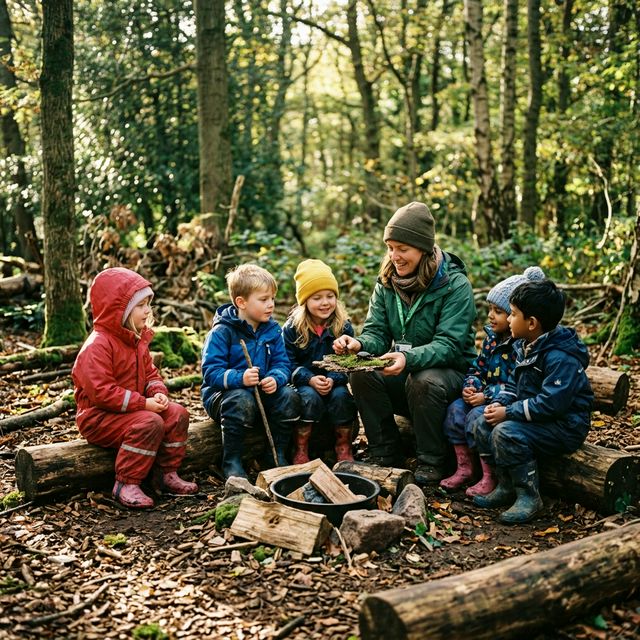
A forest school is not a school in the traditional sense. It's a programme - usually running for a half-day each week - in which children spend sustained time in a natural environment, almost always a woodland or similar green space. The idea is deceptively simple: take children outside, regularly, to the same place, and let them learn through play, exploration, and managed risk.
What makes forest school distinctive is its structure. Sessions are led by a practitioner who holds a Level 3 Forest School qualification - a nationally recognised standard that covers child development, risk assessment, ecological knowledge, and the pedagogical principles of outdoor learning. This isn't a teaching assistant with a clipboard standing by a tree. It's a trained specialist whose job is to create the conditions for children to direct their own learning in nature.
Origins in Scandinavia
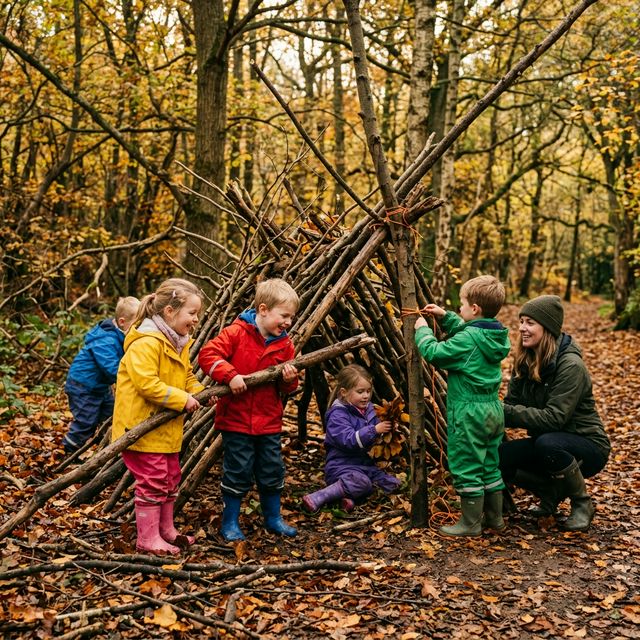
The concept comes from Denmark and Sweden, where udeskole (outdoor school) and friluftsliv (open-air living) have been central to childhood education for decades. In Scandinavian countries, it's entirely normal for nursery-age children to spend most of their day outdoors, whatever the weather. The approach arrived in the UK in the mid-1990s, when early years practitioners visiting Denmark were struck by the confidence, resilience, and social skills of the children they observed.
Since then, forest school has grown rapidly across England. Our data shows that over 5,100 primary schools, along with hundreds of nurseries and secondary schools, now offer some form of forest school programme. That's roughly one in four primaries - a remarkable expansion for an approach that barely existed here 25 years ago.
What Actually Happens?
A typical forest school session lasts two to three hours and follows a loose but intentional rhythm. Children gather in a circle for a welcome and a tuning-in activity - often a period of quiet listening to the sounds of the woodland. The practitioner then introduces an "invitation" - a suggested activity like shelter building, fire lighting, whittling, or nature art. Children are free to take up the invitation or follow their own interests. The session usually includes a snack break, a story, and a closing reflection.
The key principle is that children revisit the same site repeatedly over weeks and months. This isn't a one-off trip to the woods. It's a sustained relationship with a place - watching it change through the seasons, returning to a favourite tree, adding to a shelter built last month. This long-term connection is what separates forest school from a nature walk.
The Forest School Association defines six core principles: long-term, regular sessions in a natural environment; a high ratio of adults to children; activities that support holistic development (social, emotional, physical, cognitive); a child-led approach where learners initiate and drive their own experiences; sessions led by a Level 3 qualified practitioner; and an ethos that uses observation and reflection to guide future sessions.
Forest School vs Outdoor Learning
These two terms get used interchangeably, but they mean quite different things. Understanding the distinction matters, because a school advertising "outdoor learning" isn't necessarily offering a forest school programme - and vice versa.
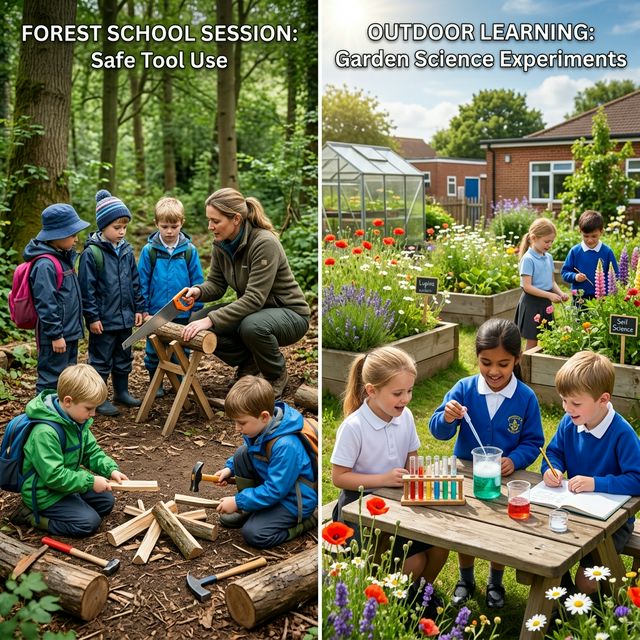
🌲 Forest School
A specific pedagogy with a clear definition and set of principles. Requires a Level 3 qualified practitioner. Takes place in woodland or a natural environment, not a school playground. Sessions are regular and long-term - the same group returns to the same site week after week, usually for at least a term. The approach is child-led: activities emerge from children's interests rather than a predetermined lesson plan.
🌿 Outdoor Learning
A broad umbrella term covering any teaching or learning that happens outside. This includes gardening clubs, outdoor maths lessons, nature walks, pond dipping, outdoor PE, and using the school grounds for science. It doesn't require a specialist qualification - any teacher or teaching assistant can lead outdoor learning. It can happen anywhere: the playground, the school garden, a local park.
Neither is better than the other - they serve different purposes. Forest school offers deeper, more sustained engagement with nature and places a strong emphasis on emotional and social development. Outdoor learning is more flexible and can be integrated into everyday teaching across any subject. Many of the best schools offer both: regular forest school sessions for specific year groups, alongside a culture of taking learning outside whenever the opportunity arises.
When looking at schools, it's worth asking which they offer. A school that says it does "forest school" should be able to tell you who their qualified practitioner is, where sessions take place, and how often children attend. If they can't answer those questions clearly, what they're offering is likely outdoor learning rather than forest school - which is still valuable, but different.
How to Find a School with a Forest School
Forest school provision isn't evenly distributed. Some local authorities have embraced it enthusiastically, with the majority of their primary schools offering programmes. Others have very little. The picture is also complicated by the fact that there's no central register of forest schools - unlike Ofsted ratings or SATs results, nobody collects this data nationally.
That's why we built the interactive forest schools map. We've analysed the websites of every school across the UK to identify which ones mention forest school or outdoor learning programmes. The map shows the density of provision across every local authority, and you can filter by school phase and category.
Questions to Ask at Open Days
If a school mentions forest school on its website or in its prospectus, that's a good starting point. But it's worth digging deeper. Forest school can mean different things in different schools - some run weekly sessions for every class, while others offer a single term of forest school for one year group.
At open days or during school visits, these are the questions that will give you the clearest picture of what's actually on offer:
A school with a genuinely embedded forest school programme will answer these questions easily and enthusiastically. If the answers are vague - "we sometimes go outside" or "we did it last year" - the provision may be less established than the marketing suggests. That doesn't make it a bad school, but it's worth knowing what you're getting.
Forest Schools and Children with SEN
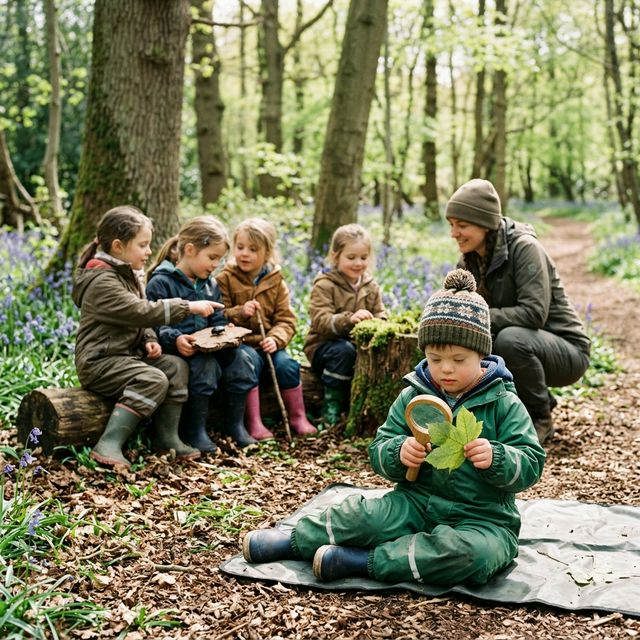
If there's one group of children for whom forest school can be particularly powerful, it's those with special educational needs. The research here is consistent and compelling: children with autism, ADHD, anxiety, sensory processing difficulties, and social, emotional, and mental health needs often flourish in forest school settings in ways they don't in the classroom.
Why the Outdoors Works Differently
The classroom is an intense sensory environment. Strip lighting, background noise, the proximity of thirty other children, the expectation to sit still and focus - for many children with SEN, this is exhausting. The woodland offers something fundamentally different. Natural light replaces fluorescent. Birdsong replaces the hum of a projector. Space is abundant. Movement is encouraged. The social dynamics change too: without desks and rows, the hierarchies and pressures of the classroom dissolve.
For autistic children, the woodland provides rich sensory input - the texture of bark, the smell of damp earth, the sound of wind in the canopy - without the overwhelming, unpredictable stimuli of indoor spaces. Several studies have found that autistic children show improved eye contact, verbal communication, and cooperative play during forest school sessions compared to classroom settings.
For children with ADHD, the freedom to move is transformative. Forest school doesn't ask children to sit still. It asks them to climb, build, dig, carry, balance, and explore. The physical engagement that would be considered disruptive in a classroom is exactly what's invited in the woods.
For children with anxiety, the low-stakes nature of forest school is key. There are no tests, no right answers, no performance expectations. A child who freezes when asked to read aloud might happily lead a group in building a shelter. The success criteria are different, and for many anxious children, that difference is liberating.
Research highlight: A 2023 study from the University of Plymouth found that children with social, emotional, and mental health needs who attended weekly forest school sessions for a year showed statistically significant improvements in self-regulation, peer relationships, and emotional resilience compared to a control group. The effects were strongest for children who had the least access to nature outside school.
What to Look For
If your child has SEN and you're considering a school with forest school provision, it's worth checking whether the forest school programme is available to all children or only to specific groups. Some schools use forest school as a targeted intervention for children who find the classroom challenging - which can be excellent, but it's different from whole-class provision.
Ask whether the forest school leader has experience working with children who have needs similar to your child's. A good practitioner will be able to talk confidently about how they adapt sessions for different learners - and will welcome the conversation.
Note: The information in this guide is based on publicly available data and research. Forest school availability can change - always check directly with schools for the most up-to-date information about their provision.