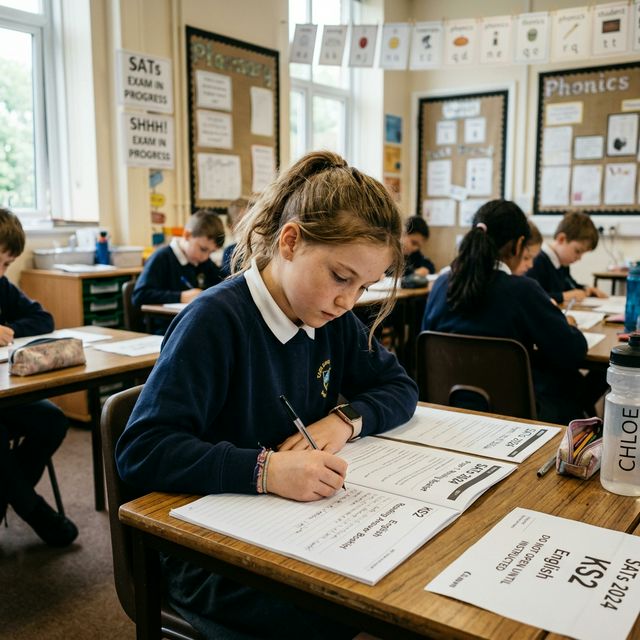
What Are SATs?
SATs - officially called Standard Assessment Tests, though the Department for Education prefers "national curriculum assessments" - are the end-of-primary tests taken by children in Year 6. They're the only formal exams most children encounter before GCSEs, and they generate more anxiety among parents than they probably should.
The tests cover three areas: reading (a single paper with questions based on three texts), maths (two papers - an arithmetic test and a reasoning test), and grammar, punctuation and spelling (often called GPS or SPaG, with a short-answer paper and a spelling test). Writing is assessed separately by teachers, not by an external test.
It's worth understanding who the tests are really for. SATs exist primarily to hold schools accountable, not to assess individual children. The government uses the results to measure school performance, compare schools nationally, and identify where intervention might be needed. For your child individually, the results matter less than you might think - secondary schools typically conduct their own assessments in Year 7 and set children accordingly.
What happened to KS1 SATs? Until 2023, children in Year 2 also sat SATs. These were scrapped and replaced by teacher assessments from the 2023-24 academic year. Teachers now assess Year 2 children against the national curriculum standards without formal tests. The Reception Baseline Assessment (RBA), introduced in 2021, is used instead to measure progress from the start of school.
Understanding the Scores
SATs results are reported as scaled scores ranging from 80 to 120. This is the concept that confuses most parents, because the raw mark (the number of questions answered correctly) is converted to a standardised scale to ensure comparability across years. A scaled score of 100 is the threshold for "meeting the expected standard".
Below Expected (80-99)
A score below 100 means a child hasn't met the expected standard in that subject. This doesn't mean they've failed - it means they're working below the level the government expects for their age. Around 25-30% of children score below 100 in reading and maths.
Expected & Above (100-120)
A score of 100 or above means the expected standard is met. Scores of 110+ are often described as "working at greater depth" or "higher standard", though there's no official threshold. Nationally, about 60-65% of children reach the expected standard across all three subjects combined.
The conversion from raw marks to scaled scores changes each year, because the tests vary in difficulty. This means a raw score of 35 might give a scaled score of 100 one year but 102 the next. You can't directly compare raw marks across years, but you can compare scaled scores - that's the whole point of the scaling.
You can compare how schools perform on SATs using our school search tool - each school's performance page shows the percentage of children reaching the expected standard and the average scaled score in each subject.
Preparation and Timing
KS2 SATs take place during a specific week in May, set by the Department for Education each year. The tests are sat on Monday to Thursday of that week, with one or two papers per day. Results arrive at schools in July and are shared with parents before the end of the summer term.
Schools handle preparation differently. Most will begin focused revision in the spring term, using past papers and targeted teaching. Some schools take a low-key approach; others create significant pressure. As a parent, you know your child best. Some children benefit from practice papers at home - they reduce anxiety by making the format familiar. Others find extra work stressful and counterproductive.
If you want to help at home, past papers are freely available from the GOV.UK website. Working through one paper in test conditions - timed, quiet, no help - gives your child a good sense of what to expect. But don't overdo it. Daily practice papers for months before the test is more likely to cause burnout than improvement.
Reading widely and regularly is the single best preparation for the reading paper. The texts used in SATs are deliberately varied - fiction, non-fiction, poetry - and children who read broadly are better prepared to handle unfamiliar material under time pressure. Maths fluency (knowing times tables automatically, being comfortable with basic operations) matters more for the arithmetic paper than specific test technique.
Keeping It in Perspective
SATs are a snapshot. They test a narrow range of skills on a single week in May. They don't measure creativity, resilience, kindness, or any of the qualities that will matter most in your child's life. A child who scores 98 is not meaningfully different from one who scores 102, despite falling on different sides of the "expected standard" line.
The results do not follow children into secondary school in any meaningful way. Secondary schools may use them for initial setting in Year 7, but most re-assess children within the first few weeks using their own tests. No employer or university will ever ask about SATs results. By the time your child sits GCSEs, SATs will be a distant memory.
If your child is anxious, the most helpful thing you can do is model calmness. Children pick up on parental stress. Reassure them that the tests are one small part of their education, that you're proud of their effort regardless of the outcome, and that their wellbeing matters more than any score. Research consistently shows that children perform better when they feel supported and relaxed, not pressured.
Note: SATs arrangements can change year to year. For the most up-to-date information on test dates, format, and reporting, visit the DfE guidance on KS2 assessments.